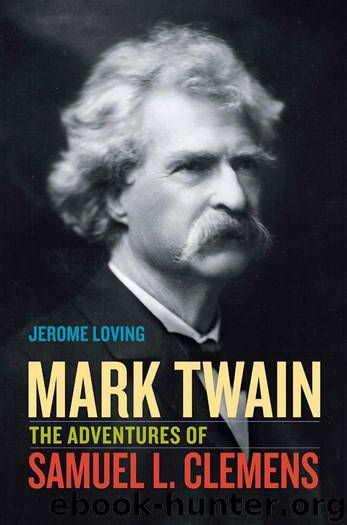
Mark Twain - The Adventures of Samuel L. Clemens by Jerome Loving
Author:Jerome Loving [Loving, Jerome]
Language: eng
Format: epub
Publisher: University of California Press
Published: 2010-03-30T22:00:00+00:00
PART III
The Artist and the Businessman
31 Associations New and Old
A Tramp Abroad would be Mark Twain’s last book with the American Publishing Company for years to come. It had been a difficult work to finish, what with all the cuts and revisions. Yet, probably because of its advance publicity by way of early reviews and published excerpts, the book, released in March 1880, sold well—in its first year more than sixty thousand copies in the United States. Elisha Bliss died the following fall. Twain had been less and less satisfied with the man who had sold so many of his books by subscription. Paradoxically, it was the success of A Tramp Abroad that brought about the rupture in his eleven-year streak with the Hartford publisher. He broke with Bliss when he realized that the de facto “half profit,” or fifty-fifty split between author and publisher that Bliss had agreed to since Roughing It (amounting to 7.5 percent of the list price), was a lie. When for the first time the term “half profit” actually appeared in the contract for A Tramp, Twain found that he made significantly more money than he had on all the previous books.1
He had also been courted for some time by James R. Osgood, who had come up through the ranks at Ticknor and Fields of Boston. By the late 1870s, Osgood had bought out the original owners and eventually joined forces with Henry Houghton. But that arrangement had soon foundered, and by 1881 he was in effect starting over as James R. Osgood and Company without Houghton’s old list of established authors.2 Now dispossessed of Emerson as well as the Schoolroom poets of Boston, Osgood needed to expand his range of authors—indeed, extend it to the widening class of readers that improved transportation and the rapid postwar advancement of print technology had created by bringing down the price of the average book. His new acquisition of authors who wrote in the vernacular and appealed to this broader readership included not only the humorist Mark Twain but also the controversial poet Walt Whitman.
Not that the first major book Osgood published—or copublished—with Twain was written in the vernacular. The Prince and the Pauper was nonetheless published as a subscription book. This method of book sales, which probably inspired the Sears Roebuck catalog as a way to reach potential customers beyond the urban bookshops, turned out not to be Osgood’s strong suit, but the general arrangement between the publisher and Twain evidently worked out well enough for their association to carry over to Life on the Mississippi. In effect, with Osgood, Twain reversed the unfair ratio between publisher and author that he had resented in his dealings with Bliss, agreeing to pay Osgood exactly the 7.5 percent royalty Bliss had paid him on Roughing It. Moreover, Twain, after Bliss, still needed somebody to manage his literary affairs. In fact, the need was even more acute because his business interests had begun to expand beyond simple nonliterary inventions of his own.
Download
This site does not store any files on its server. We only index and link to content provided by other sites. Please contact the content providers to delete copyright contents if any and email us, we'll remove relevant links or contents immediately.
4 3 2 1: A Novel by Paul Auster(12393)
The handmaid's tale by Margaret Atwood(7764)
Giovanni's Room by James Baldwin(7346)
Asking the Right Questions: A Guide to Critical Thinking by M. Neil Browne & Stuart M. Keeley(5775)
Big Magic: Creative Living Beyond Fear by Elizabeth Gilbert(5772)
Ego Is the Enemy by Ryan Holiday(5450)
The Body: A Guide for Occupants by Bill Bryson(5097)
On Writing A Memoir of the Craft by Stephen King(4944)
Ken Follett - World without end by Ken Follett(4732)
Adulting by Kelly Williams Brown(4574)
Bluets by Maggie Nelson(4556)
Eat That Frog! by Brian Tracy(4540)
Guilty Pleasures by Laurell K Hamilton(4449)
The Poetry of Pablo Neruda by Pablo Neruda(4109)
Alive: The Story of the Andes Survivors by Piers Paul Read(4033)
White Noise - A Novel by Don DeLillo(4010)
Fingerprints of the Gods by Graham Hancock(4004)
The Book of Joy by Dalai Lama(3986)
The Bookshop by Penelope Fitzgerald(3853)
